<?xml version="1.0" encoding="UTF-8"?>
<?xml-stylesheet type="text/xsl" href="/wp-content/themes/feed/atom.xsl"?>
<feed
        xmlns="http://www.w3.org/2005/Atom"
        xmlns:wwe="http://release.wwe.com/atom/1.0"
        xmlns:thr="http://purl.org/syndication/thread/1.0"
        xmlns:taxo="http://purl.org/rss/1.0/modules/taxonomy/"
        xml:lang="en-US"
        xml:base="https://www.lbdlawfirm.com/wp-atom.php"
	>
    <title type="text">LBD Law, PLLC</title>
    <subtitle type="text">LBD Law, PLLC</subtitle>

    <updated>2026-11-05T00:37:23Z</updated>

    <link rel="alternate" type="text/html" href="https://www.lbdlawfirm.com" />
    <id>https://www.lbdlawfirm.com/feed/atom/</id>
    <link rel="self" type="application/atom+xml" href="https://www.lbdlawfirm.com/feed/atom/?forceByPassCache=0.9121038144079284" />
	
	<generator uri="https://wordpress.org/" version="6.9.10">WordPress</generator>
<icon>/wp-content/uploads/sites/1404695/2025/04/cropped-lbdSiteicon-32x32.png</icon>
        <entry>
            <author>
									                    <name>On Behalf of LBD Law, PLLC</name>
				            </author>
            <title type="html"><![CDATA[Can I move out of state with my child after a Texas divorce?]]></title>
            <link rel="alternate" type="text/html" href="https://www.lbdlawfirm.com/blog/2026/11/can-i-move-out-of-state-with-my-child-after-a-texas-divorce/" />
            <id>https://www.lbdlawfirm.com/?p=49734</id>
            <updated>2026-11-05T00:37:23Z</updated>
            <published>2026-11-05T00:37:23Z</published>
					<taxo:topics><![CDATA[-]]></taxo:topics>
            <summary type="html"><![CDATA[After a divorce, you may want to relocate for a new job, to be closer to family, or simply for a fresh start. Moving with your child, however, is not always a decision you can make on your own. Texas law places meaningful limits on relocation when a custody order is in place. What does Texas law say about relocation?…]]></summary>
			                <content type="html" xml:base="https://www.lbdlawfirm.com/blog/2026/11/can-i-move-out-of-state-with-my-child-after-a-texas-divorce/"><![CDATA[After a divorce, you may want to relocate for a new job, to be closer to family, or simply for a fresh start. Moving with your child, however, is not always a decision you can make on your own. Texas law places meaningful limits on relocation when a custody order is in place.
<h2>What does Texas law say about relocation?</h2>
Many Texas custody orders include a geographic restriction that limits where the custodial parent may live with the child. These restrictions often confine the child's primary residence to a specific county or a defined group of counties.

If your order includes such a restriction, you cannot move beyond that area without either a court order permitting the move or the other parent's written consent. Moving without satisfying one of those two requirements puts you in violation of a court order. That can lead to <a href="https://statutes.capitol.texas.gov/GetStatute.aspx?Code=FA&amp;Value=157" target="_blank" rel="noopener noreferrer" data-wpel-link="external">contempt proceedings</a>, a modification of your existing custody arrangement, or other enforcement actions. Courts take these violations seriously, and acting without legal guidance first can significantly harm your position.
<h2>How do courts decide relocation cases?</h2>
When you ask the court for permission to move, the judge applies the best interests of the child standard. Texas courts have identified several factors that influence this analysis, including the reason for the proposed move, the quality of life the new location would offer the child, how the relocation would affect the child's relationship with the non-relocating parent, the child's age and emotional needs, and the child's existing ties to their school, community, and extended family.

The other parent has the right to contest your request, and courts weigh the benefits of the move against any potential harm to the child's bond with both parents. A well-prepared relocation request that addresses each of these factors directly gives you the strongest foundation going into that hearing.
<h2>Planning your relocation with legal guidance</h2>
Relocation cases require careful planning and, in most situations, court involvement. Speaking with a <a href="/family-law/child-custody-and-support/" target="_blank" rel="noopener" data-wpel-link="internal">Texas family law attorney</a> before you make any decisions helps you understand whether your order includes a geographic restriction, what approval process applies, and how to present the strongest possible case for your move.

&nbsp;]]></content>
						        </entry>
	        <entry>
            <author>
									                    <name>On Behalf of LBD Law, PLLC</name>
				            </author>
            <title type="html"><![CDATA[How protective orders affect child custody and divorce in Texas]]></title>
            <link rel="alternate" type="text/html" href="https://www.lbdlawfirm.com/blog/2026/10/how-protective-orders-affect-child-custody-and-divorce-in-texas/" />
            <id>https://www.lbdlawfirm.com/?p=49732</id>
            <updated>2026-10-23T23:10:00Z</updated>
            <published>2026-10-23T23:10:00Z</published>
					<taxo:topics><![CDATA[-]]></taxo:topics>
            <summary type="html"><![CDATA[When safety concerns arise during a Texas divorce or custody dispute, the legal process changes in meaningful ways. A protective order is not an informal agreement or standard restraining order. It is a binding judicial order that carries civil and criminal consequences for violations and can reshape how a family court approaches conservatorship, parenting time, property division, and spousal maintenance.…]]></summary>
			                <content type="html" xml:base="https://www.lbdlawfirm.com/blog/2026/10/how-protective-orders-affect-child-custody-and-divorce-in-texas/"><![CDATA[When safety concerns arise during a Texas divorce or custody dispute, the legal process changes in meaningful ways. A protective order is not an informal agreement or standard restraining order. It is a binding judicial order that carries civil and criminal consequences for violations and can reshape how a family court approaches conservatorship, parenting time, property division, and spousal maintenance.
<h2>What is a Texas protective order?</h2>
Under Texas Family Code Chapter 85, a court may issue a protective order after finding that <a href="https://statutes.capitol.texas.gov/?tab=1&amp;code=FA&amp;chapter=FA.85&amp;artSec=85.001" target="_blank" rel="noopener noreferrer" data-wpel-link="external">family violence has occurred</a>. Depending on the circumstances, the order may prohibit the respondent from communicating with protected parties, require the respondent to vacate the marital home regardless of whose name appears on the lease or deed, establish distance requirements from a spouse's home, workplace, or the children's school, and suspend the respondent's right to possess firearms under both Texas and federal law.

The order addresses immediate safety, but its legal effects extend into the divorce and custody proceedings that follow.
<h2>How a protective order affects conservatorship</h2>
Texas courts generally presume that appointing both parents as joint managing conservators serves a child's best interests. Under Texas law, however, <a href="https://statutes.capitol.texas.gov/?tab=1&amp;code=FA&amp;chapter=FA.153&amp;artSec=" target="_blank" rel="noopener noreferrer" data-wpel-link="external">credible evidence</a> of a history or pattern of family violence changes that outcome significantly. When such evidence is presented, the court may not appoint joint managing conservators. Instead, the court may grant the non-violent parent sole managing conservatorship, carrying primary decision-making authority over the child's education, medical care, and legal matters.

Texas law also creates a rebuttable presumption against unsupervised visitation when a history or pattern of abuse is documented. A judge may require parenting time at a supervised facility or under approved third-party supervision, mandate exchanges at a neutral location such as a police station or public building, and restrict direct parental communication to monitored co-parenting platforms. These arrangements are designed to protect the child's safety while preserving the parent-child relationship where the court finds it appropriate.
<h2>How a protective order affects property division and spousal maintenance</h2>
Texas divides community property in a just and right manner. Courts may consider fault in the breakdown of the marriage, including documented family violence, when deciding whether to award a disproportionate share of marital assets to the victimized spouse.

On spousal maintenance, Texas law allows a court to award post-divorce support when one spouse has a criminal conviction or deferred adjudication for family violence committed against the other spouse or a child during the marriage. This ground applies regardless of how long the marriage lasted, making it available even when the couple would otherwise fall short of the general ten-year threshold.
<h2>Protecting your rights in Rockwall</h2>
Protective order proceedings carry real consequences for both parents, and decisions made at this stage can affect conservatorship arrangements and financial outcomes for years to come. Whether you are seeking protection for yourself and your children or responding to allegations, having clear legal guidance helps ensure your situation is presented accurately and your long-term interests are protected. Contact a <a href="/family-law/child-custody-and-support/" target="_blank" rel="noopener" data-wpel-link="internal">family law attorney in Rockwall</a> to discuss your circumstances and understand your options under Texas law.]]></content>
						        </entry>
	        <entry>
            <author>
									                    <name>On Behalf of LBD Law, PLLC</name>
				            </author>
            <title type="html"><![CDATA[What to expect at your first court appearance in Texas]]></title>
            <link rel="alternate" type="text/html" href="https://www.lbdlawfirm.com/blog/2026/10/what-to-expect-at-your-first-court-appearance-in-texas/" />
            <id>https://www.lbdlawfirm.com/?p=49718</id>
            <updated>2026-10-08T08:32:46Z</updated>
            <published>2026-10-08T08:32:46Z</published>
					<taxo:topics><![CDATA[-]]></taxo:topics>
            <summary type="html"><![CDATA[Going to court for the first time can be stressful, especially when you do not know what the judge may ask, how long the hearing will take or what you should bring. The first appearance may involve an initial magistrate proceeding, an arraignment or another hearing, depending on the case and court. Understanding what may happen can help you feel…]]></summary>
			                <content type="html" xml:base="https://www.lbdlawfirm.com/blog/2026/10/what-to-expect-at-your-first-court-appearance-in-texas/"><![CDATA[Going to court for the first time can be stressful, especially when you do not know what the judge may ask, how long the hearing will take or what you should bring. The first appearance may involve an initial magistrate proceeding, an arraignment or another hearing, depending on the case and court. Understanding what may happen can help you feel more prepared.
<h2>What happens during an arraignment</h2>
During an arraignment, the judge generally informs you of the <a href="https://tcss.legis.texas.gov/resources/CR/htm/CR.45A.htm" data-wpel-link="external" target="_blank" rel="noopener noreferrer">criminal charges</a> filed against you and addresses your plea. You have the right to know what you are accused of and the potential penalties associated with the charges.

If you cannot afford an attorney and meet the requirements for court-appointed counsel, the court may consider your request for legal representation. The process for requesting appointed counsel depends on the circumstances of your case.

A defendant may enter a plea at arraignment. The appropriate plea depends on the circumstances of the case and the defendant's legal advice. Entering a not-guilty plea does not prevent the defense from discussing a possible agreement with the prosecutor later.
<h2>How bail and conditions work</h2>
The court may also address bail and conditions of release. When setting these conditions, the judge may consider factors such as the seriousness of the charges, your ties to the community and whether you are likely to appear for future hearings.

Release conditions may include travel restrictions, regular check-ins or other requirements. Failing to follow these conditions can create additional legal problems and may result in arrest or a change in your bail.
<h2>What you should bring and do</h2>
Arrive at least 30 minutes early so you have enough time to locate the courtroom and pass through security. Bring a photo ID and documents related to your case. Turn off or silence your phone before entering the courtroom.

Address the judge as "Your Honor" and follow courtroom instructions carefully. Stand when required, speak clearly and avoid interrupting others.
<h2>Moving forward</h2>
Your <a href="https://www.lbdlawfirm.com/criminal-defense/" data-wpel-link="internal">first court appearance</a> is an important step, but it does not determine the final outcome of your case. Understanding the charges, following court orders and preparing for future hearings can help you navigate the process with greater confidence.]]></content>
						        </entry>
	        <entry>
            <author>
									                    <name>On Behalf of LBD Law, PLLC</name>
				            </author>
            <title type="html"><![CDATA[Are prenups enforceable in Texas? What you need to know]]></title>
            <link rel="alternate" type="text/html" href="https://www.lbdlawfirm.com/blog/2026/09/are-prenups-enforceable-in-texas-what-you-need-to-know/" />
            <id>https://www.lbdlawfirm.com/?p=49677</id>
            <updated>2026-09-19T14:07:26Z</updated>
            <published>2026-09-19T14:07:26Z</published>
					<taxo:topics><![CDATA[-]]></taxo:topics>
            <summary type="html"><![CDATA[The short answer is yes. Whether a Texas prenuptial agreement will hold up in court, however, depends on proper execution and making sure specific terms meet Texas legal standards.  What makes a prenuptial agreement valid in Texas? There are certain legal requirements for a prenup to be considered valid. First, an oral agreement is not acceptable. It must be in…]]></summary>
			                <content type="html" xml:base="https://www.lbdlawfirm.com/blog/2026/09/are-prenups-enforceable-in-texas-what-you-need-to-know/"><![CDATA[<span style="font-weight: 400;">The short answer is yes. Whether a Texas prenuptial agreement will hold up in court, however, depends on</span> proper execution and making sure specific terms meet <span style="font-weight: 400;">Texas legal standards. </span>
<h2><span style="font-weight: 400;">What makes a prenuptial agreement valid in Texas?</span></h2>
<span style="font-weight: 400;">There are certain legal requirements for a prenup to be considered valid. First, an oral agreement is not acceptable. It must be in writing. Second, both parties must sign the agreement voluntarily. Finally, unlike a standard contract, a prenup needs no consideration. </span>
<h2><span style="font-weight: 400;">When Texas courts may not enforce a prenuptial agreement</span></h2>
<span style="font-weight: 400;">Courts may decline to enforce a prenuptial agreement under certain conditions. For instance, a challenging party may invalidate a prenup if they prove one of the following: </span>
<ul>
 	<li style="font-weight: 400;" aria-level="1"><span style="font-weight: 400;">The party did not sign it voluntarily. </span></li>
 	<li style="font-weight: 400;" aria-level="1"><span style="font-weight: 400;">The </span><a href="https://www.law.cornell.edu/wex/unconscionable#:~:text=The%20adjective%20is%20frequently%20used%20in%20the%20context%20of%20contract%20law%20for%20contracts%20that%20have%20grossly%20oppressive%20and%20unfair%20terms.%20When%20a%20court%20finds%20a%20contract%20unconscionable%2C%20it%20is%20unenforceable.%20See%20unconscionability." data-wpel-link="external" target="_blank" rel="noopener noreferrer"><span style="font-weight: 400;">agreement was unconscionable</span></a><span style="font-weight: 400;"> when signed, and prior to finalizing it, the contesting individual lacked realistic awareness of the opposition's wealth, having neither received transparent monetary details nor formally relinquished their right to review such information.</span></li>
</ul>
<span style="font-weight: 400;">Beyond these specific grounds, a judge may evaluate the overall circumstances present at the time of execution. </span>
<h2><span style="font-weight: 400;">What a prenuptial agreement can cover</span></h2>
<span style="font-weight: 400;">Texas law allows parties to address a range of financial matters in a prenuptial agreement. These may include:</span>
<ul>
 	<li style="font-weight: 400;" aria-level="1"><span style="font-weight: 400;">Rights and obligations tied to each party's property</span></li>
 	<li style="font-weight: 400;" aria-level="1"><span style="font-weight: 400;">Modification or elimination of spousal support (alimony)</span></li>
 	<li style="font-weight: 400;" aria-level="1"><span style="font-weight: 400;">Creation of a will or trust to carry out the agreement's terms </span></li>
</ul>
<span style="font-weight: 400;">Prenuptial agreements may not adversely affect a child's right to support. Agreements also cannot include terms that go against public policy or that impose a criminal penalty. </span>
<h2><span style="font-weight: 400;">Putting your prenuptial agreement together</span></h2>
<span style="font-weight: 400;">Because the rules surrounding asset disclosure and unconscionability are incredibly strict, a DIY prenup is highly risky. </span>It is strongly recommended that both parties hire an experienced Texas <b data-path-to-node="35" data-index-in-node="187"><span style="font-weight: 400;"><a href="https://www.lbdlawfirm.com/family-law/" data-wpel-link="internal">family law</a></span> </b>attorney to draft and review the document.]]></content>
						        </entry>
	        <entry>
            <author>
									                    <name>On Behalf of LBD Law, PLLC</name>
				            </author>
            <title type="html"><![CDATA[Most Texas Expunction Pages Still Cite a Repealed Statute. Here Is What Chapter 55A Changed on January 1, 2025]]></title>
            <link rel="alternate" type="text/html" href="https://www.lbdlawfirm.com/blog/2026/09/most-texas-expunction-pages-still-cite-a-repealed-statute-here-is-what-chapter-55a-changed-on-january-1-2025/" />
            <id>https://www.lbdlawfirm.com/?p=49720</id>
            <updated>2026-10-09T14:30:23Z</updated>
            <published>2026-09-09T13:41:45Z</published>
					<taxo:topics><![CDATA[-]]></taxo:topics>
            <summary type="html"><![CDATA[QUICK ANSWER Is Texas expunction still under Article 55.01, or is it Chapter 55A now? It is Chapter 55A. Texas expunction law is now Code of Criminal Procedure Chapter 55A, added by House Bill 4504 and effective January 1, 2025. The same bill repealed the old Chapter 55, which is where Article 55.01 lived. The citation changed. The rules for…]]></summary>
			                <content type="html" xml:base="https://www.lbdlawfirm.com/blog/2026/09/most-texas-expunction-pages-still-cite-a-repealed-statute-here-is-what-chapter-55a-changed-on-january-1-2025/"><![CDATA[<img class="alignnone wp-image-49722 size-full" src="/wp-content/uploads/sites/1404695/2026/10/unnamed-99.png" alt="Chapter 55A" width="512" height="269" />
<blockquote><b>QUICK ANSWER</b>

<b>Is Texas expunction still under Article 55.01, or is it Chapter 55A now?</b>

It is Chapter 55A. Texas expunction law is now Code of Criminal Procedure Chapter 55A, added by House Bill 4504 and effective January 1, 2025. The same bill repealed the old Chapter 55, which is where Article 55.01 lived. The citation changed. The rules for who qualifies did not, because House Bill 4504 was a nonsubstantive revision.</blockquote>
<h2><span style="font-weight: 400;">You Were Reading The Right Law Under The Wrong Number</span></h2>
<span style="font-weight: 400;">If you have spent an evening searching for whether your old arrest can come off your record, you have almost certainly read the words “Article 55.01.” It is on law firm pages. It is on court forms. It is in the article a friend sent you.</span>

<span style="font-weight: 400;">And then you found something that said Chapter 55A, and now you are not sure which one is real, or whether the rules changed while you were not looking.</span>

<span style="font-weight: 400;">Here is the short version. You were reading the right law. It just does not live at that address anymore.</span>

<span style="font-weight: 400;">Nothing you learned about your own eligibility is automatically wrong because the page you read used the old number. That is worth saying out loud, because people in this situation tend to assume the worst about their own case first.</span>

<span style="font-weight: 400;">If you are starting from scratch on all of this, the wider picture of how record clearing works in Texas, and how an expunction differs from an order of nondisclosure, is on </span><b>Clearing Your Record: Expunctions and Orders of Nondisclosure</b><span style="font-weight: 400;">. This page is about one narrower thing, which is the citation that moved.</span>
<h2><span style="font-weight: 400;">What Happened To Article 55.01 On January 1, 2025?</span></h2>
<span style="font-weight: 400;">Two things happened on the same day, in the same bill.</span>

<span style="font-weight: 400;">Texas Code of Criminal Procedure Chapter 55A was added by Acts 2023, 88th Legislature, Regular Session, Chapter 765 (House Bill 4504), Section 1.001, effective January 1, 2025. That is the chapter where Texas expunction law now lives.</span>

<span style="font-weight: 400;">The old chapter was repealed by the same act. The note on the old chapter reads:</span>
<blockquote><span style="font-weight: 400;">“this chapter was repealed by Acts 2023, 88th Leg., R.S., Ch. 765 (H.B. 4504), Sec. 3.001(6), eff. January 1, 2025.”</span></blockquote>
<span style="font-weight: 400;">So Article 55.01 is not a competing version of the law, and it is not a stricter or older set of rules someone is trying to hold you to. It is a repealed citation. When a page cites it today, that page has not been updated since before 2025.</span>
<h2><span style="font-weight: 400;">Did The Rules For Who Qualifies Change Too?</span></h2>
<span style="font-weight: 400;">No, and this is the part that matters most to you.</span>

<span style="font-weight: 400;">House Bill 4504 came out of a project the Texas Legislative Council is required to run under Section 323.007 of the Government Code, a complete nonsubstantive revision of the Texas statutes. The Legislature’s own bill analysis says it plainly:</span>
<blockquote><span style="font-weight: 400;">“H.B. 4504 is a nonsubstantive revision of Texas law. The substance of the law has not been altered.”</span></blockquote>
<span style="font-weight: 400;">The same analysis describes what the bill was for: “The sole purpose of these provisions is to compile the relevant law, arrange it in a logical fashion, and rewrite it without altering its meaning or legal effect.”</span>

<span style="font-weight: 400;">That is a legislative housekeeping project, not a change in your rights. One long article got broken into a chapter organized by situation. The eligibility conditions came along with it.</span>

<span style="font-weight: 400;">We want to be careful here, because “nothing changed” is easy to say and easy to overpromise. What did not change is the substance of the expunction law. What did change is every citation, every article number, and the structure a lawyer or a clerk uses to find your situation. That second part is not nothing. It is why an old form or an old petition template can fail today even when the underlying facts are fine.</span>
<h2><span style="font-weight: 400;">Where Did The Old Article 55.01 Rules End up in Chapter 55A?</span></h2>
<span style="font-weight: 400;">Chapter 55A is organized by how your case ended, which is a more useful map than one long article was. Here is where the situations people ask about actually sit now.</span>
<table style="width: 77.1264%;">
<thead>
<tr>
<th style="width: 81.9643%;"><b>What happened in your case</b></th>
<th style="width: 41.4006%;"><b>Where it lives</b></th>
</tr>
</thead>
<tbody>
<tr>
<td style="width: 81.9643%;"><span style="font-weight: 400;">You were acquitted at trial</span></td>
<td style="width: 41.4006%;"><b>Art. 55A.002</b></td>
</tr>
<tr>
<td style="width: 81.9643%;"><span style="font-weight: 400;">You received a pardon for actual innocence</span></td>
<td style="width: 41.4006%;"><b>Art. 55A.003</b></td>
</tr>
<tr>
<td style="width: 81.9643%;"><span style="font-weight: 400;">You received a pardon for another reason</span></td>
<td style="width: 41.4006%;"><b>Art. 55A.004</b></td>
</tr>
<tr>
<td style="width: 81.9643%;"><span style="font-weight: 400;">You were arrested by mistaken identity</span></td>
<td style="width: 41.4006%;"><b>Art. 55A.006</b></td>
</tr>
<tr>
<td style="width: 81.9643%;"><span style="font-weight: 400;">You were arrested, released, and never finally convicted</span></td>
<td style="width: 41.4006%;"><b>Art. 55A.051</b></td>
</tr>
<tr>
<td style="width: 81.9643%;"><span style="font-weight: 400;">You were arrested and no charge was ever filed</span></td>
<td style="width: 41.4006%;"><b>Art. 55A.052</b></td>
</tr>
<tr>
<td style="width: 81.9643%;"><span style="font-weight: 400;">Your indictment or information was dismissed or quashed</span></td>
<td style="width: 41.4006%;"><b>Art. 55A.053</b></td>
</tr>
<tr>
<td style="width: 81.9643%;"><span style="font-weight: 400;">The limitations period ran out before you could be prosecuted</span></td>
<td style="width: 41.4006%;"><b>Art. 55A.054</b></td>
</tr>
<tr>
<td style="width: 81.9643%;"><span style="font-weight: 400;">You were acquitted on appeal, or the prosecutor recommends expunction</span></td>
<td style="width: 41.4006%;"><b>Art. 55A.101</b></td>
</tr>
</tbody>
</table>
&nbsp;

<span style="font-weight: 400;">Article 55A.051 is the gateway for most people. It applies to a person arrested for a felony or misdemeanor if:</span>
<blockquote><span style="font-weight: 400;">“(1) the person has been released; (2) the charge, if any, has not resulted in a final conviction and is no longer pending; and (3) there was no court-ordered community supervision under Chapter 42A for the offense, other than for a Class C misdemeanor.”</span></blockquote>
<span style="font-weight: 400;">Read that third condition twice. It is the one that surprises people, and we come back to it below.</span>
<h2><span style="font-weight: 400;">How Long Do You Have To Wait If You Were Arrested And Never Charged?</span></h2>
<span style="font-weight: 400;">This is the number people are actually searching for, and Chapter 55A sets it out in Article 55A.052.</span>
<blockquote><b>Under Texas Code of Criminal Procedure Article 55A.052, the waiting period after an arrest where no charge was ever filed runs from the date of arrest: 180 days for a Class C misdemeanor, one year for a Class A or B misdemeanor, and three years for a felony.</b></blockquote>
<span style="font-weight: 400;">Broken out:</span>
<ul>
 	<li aria-level="1"><b>180 days from the date of arrest</b><span style="font-weight: 400;"> if the arrest was for an offense punishable as a Class C misdemeanor, and there was no felony charge arising out of the same transaction.</span></li>
 	<li aria-level="1"><b>One year from the date of arrest</b><span style="font-weight: 400;"> if the arrest was for an offense punishable as a Class B or Class A misdemeanor, and there was no felony charge arising out of the same transaction.</span></li>
 	<li aria-level="1"><b>Three years from the date of arrest</b><span style="font-weight: 400;"> if the arrest was for an offense punishable as a felony, or if there was a felony charge arising out of the same transaction.</span></li>
 	<li aria-level="1"><b>No waiting period at all</b><span style="font-weight: 400;"> if the attorney representing the state certifies that the arrest records and files are not needed for use in any criminal investigation or prosecution, including one involving another person. That fourth route is in the statute, and it is the one almost nobody knows to ask about.</span></li>
</ul>
<span style="font-weight: 400;">One more timing rule worth knowing before you plan around a court date. Under Article 55A.254, “The court shall set a hearing on an ex parte petition for expunction not earlier than the 30th day following the date the petition is filed.” Filing does not put you in front of a judge next week.</span>
<h2><span style="font-weight: 400;">Why Does An Outdated Citation On A Page Actually Matter?</span></h2>
<span style="font-weight: 400;">You might reasonably ask why any of this matters if the substance is the same. Three reasons, and they are practical rather than technical.</span>

<span style="font-weight: 400;">A page that still says Article 55.01 has not been reviewed in more than a year and a half. Whatever else is on it is the same age. That includes the waiting periods, the disqualifiers, and the description of what happens after a judge signs.</span>

<span style="font-weight: 400;">Forms and petitions carry citations. A petition built on repealed article numbers is a petition a clerk or a court can send back, and that costs you time you already waited for.</span>

<span style="font-weight: 400;">And Chapter 55A carries a provision the old chapter’s readers rarely saw. Article 55A.451 says that on release or discharge of an arrested person, “the person responsible for the release or discharge shall give the released or discharged person a written explanation of that person’s rights under this chapter and a copy of the provisions of this chapter.” If you were never handed that, you would have no reason to know any of this existed.</span>
<blockquote><span style="font-weight: 400;">If you are looking at an old arrest and trying to figure out which route in Chapter 55A your case actually falls under, that is a question worth putting in front of someone who reads the current chapter rather than a cached copy of the old one. Lara Bracamonte Davila and LBD Law, PLLC can walk through what your record shows and which article applies, so you are working from the law as it reads today.</span>

<b>CONTACT THE FIRM · <a href="/contact/" data-wpel-link="internal">www.lbdlawfirm.com/contact</a> · [nap_phone id="LOCAL-REGULAR-NUMBER-Phone"]</b></blockquote>
<h2><span style="font-weight: 400;">What Chapter 55A Still Will Not Do</span></h2>
<span style="font-weight: 400;">The recodification did not open any doors that were closed before. A few of those doors matter a great deal to real people.</span>

<span style="font-weight: 400;">Deferred adjudication above a Class C misdemeanor still blocks expunction. That is the third condition in Article 55A.051, and it catches people who completed everything the court asked of them and reasonably assumed that was the end of it. It is not a punishment for something you did wrong. It is a line in the eligibility rule. The remedy in that situation is an order of nondisclosure under Government Code Chapter 411, Subchapter E-1, which is a different remedy with different rules.</span>

<span style="font-weight: 400;">Chapter 55A also has an entire subchapter listing when expunction is prohibited. Article 55A.151 bars expunction where the offense you were acquitted of arose out of a criminal episode and you were convicted of, or remain subject to prosecution for, at least one other offense in that episode. Article 55A.154 bars the Article 55A.052 and 55A.054 routes for a person who intentionally or knowingly absconds from the jurisdiction after being released following an arrest.</span>

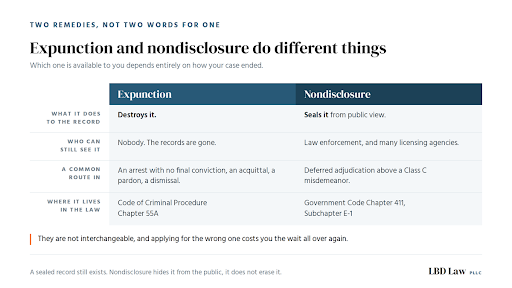
<span style="font-weight: 400;">And expunction is still not the same thing as sealing. Expunction destroys records. Nondisclosure hides them from the public and leaves them visible to law enforcement and to many licensing agencies. If your goal is a clean background check for a job or a license, which route you need depends entirely on how your case ended. That is worth sorting out before you file anything, because the two are not interchangeable and applying for the wrong one costs you the wait all over again.</span>

<img class="alignnone wp-image-49723 size-full" src="/wp-content/uploads/sites/1404695/2026/10/unnamed-998.png" alt="Expunction and nondisclosure do different things" width="512" height="288" />
<h2><span style="font-weight: 400;">Frequently Asked Questions</span></h2>
<b>Is Article 55.01 of the Texas Code of Criminal Procedure still good law?</b>

<span style="font-weight: 400;">No. Article 55.01 was part of Code of Criminal Procedure Chapter 55, which was repealed by House Bill 4504, 88th Texas Legislature, Regular Session, effective January 1, 2025. Texas expunction law is now in Code of Criminal Procedure Chapter 55A. A page or form citing Article 55.01 today is citing a repealed statute.</span>

<b>Did the move to Chapter 55A make it harder to get an expunction in Texas?</b>

<span style="font-weight: 400;">No. House Bill 4504 was a nonsubstantive revision carried out under Section 323.007 of the Texas Government Code. The Legislature’s bill analysis states that the substance of the law was not altered and that the purpose was to compile and rearrange the law without changing its meaning or legal effect. The eligibility conditions moved to new article numbers rather than changing.</span>

<b>How long after a Texas arrest with no charges filed can I ask for an expunction?</b>

<span style="font-weight: 400;">Under Texas Code of Criminal Procedure Article 55A.052, the waiting period runs from the date of arrest: 180 days for a Class C misdemeanor, one year for a Class A or B misdemeanor, and three years for a felony. Those periods apply where no indictment or information was ever presented. There is also a separate route with no waiting period if the attorney representing the state certifies the records are not needed for any criminal investigation or prosecution.</span>

<b>I completed deferred adjudication. Can I get an expunction under Chapter 55A?</b>

<span style="font-weight: 400;">Generally no, if the deferred adjudication was for anything above a Class C misdemeanor. Article 55A.051 applies only where there was no court-ordered community supervision under Chapter 42A other than for a Class C misdemeanor. In that situation the remedy people are usually looking for is an order of nondisclosure under Texas Government Code Chapter 411, Subchapter E-1, which seals a record from public view rather than destroying it.</span>

<b>What does an expunction cost to file in Texas?</b>

<span style="font-weight: 400;">There is no single statewide figure. Filing costs are set county by county and by court, so the amount in Rockwall County is not necessarily the amount in Collin, Hunt, Kaufman or Dallas County. Confirm the current fee with the district clerk in the county where the petition will be filed rather than relying on a number published on any website.</span>
<h2><span style="font-weight: 400;">Key Takeaways</span></h2>
<ul>
 	<li style="font-weight: 400;" aria-level="1"><span style="font-weight: 400;">Texas expunction moved from Code of Criminal Procedure Chapter 55 to Chapter 55A on January 1, 2025, under House Bill 4504. Article 55.01 is a repealed citation.</span></li>
 	<li style="font-weight: 400;" aria-level="1"><span style="font-weight: 400;">The substance of the law did not change. House Bill 4504 was a nonsubstantive revision, and the Legislature’s own bill analysis says the substance of the law has not been altered.</span></li>
 	<li style="font-weight: 400;" aria-level="1"><span style="font-weight: 400;">Where no charge was ever filed, Article 55A.052 sets the wait from the date of arrest at 180 days for a Class C misdemeanor, one year for a Class A or B misdemeanor, and three years for a felony.</span></li>
 	<li style="font-weight: 400;" aria-level="1"><span style="font-weight: 400;">Deferred adjudication above a Class C misdemeanor still keeps a case outside expunction under Article 55A.051. Nondisclosure under Government Code Chapter 411, Subchapter E-1 is the separate remedy.</span></li>
</ul>
<h2><span style="font-weight: 400;">Your Next Step</span></h2>
<span style="font-weight: 400;">An old arrest sitting on your record has a way of feeling permanent, especially when everything you read about it seems to disagree with itself. Most of that confusion is not about your case at all. It is about a citation that moved and a lot of pages that never got updated. The law that decides whether your record can be cleared is the same law it was two years ago, and it is written down, and it can be read.</span>

<span style="font-weight: 400;">What it cannot do is sort itself. Which article in Chapter 55A fits your situation depends on how your case actually ended, and that is a detail your paperwork knows better than your memory does.</span>

<span style="font-weight: 400;">If you want to know which route in Chapter 55A applies to your record, and whether expunction or nondisclosure is the remedy that fits, LBD Law, PLLC can look at what your case file and your record actually show and tell you plainly what is available. Knowing which of the two you are dealing with is what lets you plan instead of guess.</span>

<span style="font-weight: 400;">You can read how the two remedies fit together on </span><b>Clearing Your Record: Expunctions and Orders of Nondisclosure</b><span style="font-weight: 400;">.</span>]]></content>
						        </entry>
	        <entry>
            <author>
									                    <name>On Behalf of LBD Law, PLLC</name>
				            </author>
            <title type="html"><![CDATA[What happens at a Texas criminal arraignment?]]></title>
            <link rel="alternate" type="text/html" href="https://www.lbdlawfirm.com/blog/2026/08/what-happens-at-a-texas-criminal-arraignment/" />
            <id>https://www.lbdlawfirm.com/?p=49564</id>
            <updated>2026-08-31T16:45:17Z</updated>
            <published>2026-08-31T16:45:17Z</published>
					<taxo:topics><![CDATA[-]]></taxo:topics>
            <summary type="html"><![CDATA[A Texas criminal arraignment can feel confusing, especially if you have never been through a criminal case. You may wonder what the judge will ask, whether you need to enter a plea and what happens next. Knowing the purpose of this hearing can make the process easier to follow. What is an arraignment? Under Texas law, an arraignment is a…]]></summary>
			                <content type="html" xml:base="https://www.lbdlawfirm.com/blog/2026/08/what-happens-at-a-texas-criminal-arraignment/"><![CDATA[A Texas criminal arraignment can feel confusing, especially if you have never been through a criminal case. You may wonder what the judge will ask, whether you need to enter a plea and what happens next. Knowing the purpose of this hearing can make the process easier to follow.
<h2>What is an arraignment?</h2>
Under Texas law, an arraignment is a proceeding used to establish the defendant's identity and hear the defendant's plea. In some cases, the defendant may waive the arraignment through counsel. Texas law identifies establishing <a href="https://www.bracamontelawfirm.com/criminal-defense/" data-wpel-link="external" target="_blank" rel="noopener noreferrer">the defendant’s identity</a> and hearing the defendant's plea as the purposes of arraignment.

An arraignment is not a trial. The court does not decide guilt or innocence during this proceeding. Instead, it marks an early step in the criminal case.
<h2>What happens during the hearing?</h2>
The exact process can vary based on the type of case and the court handling it. Generally, the defendant can expect the court to address several basic matters:
<ul>
 	<li aria-level="1">The court identifies the defendant and confirms the charge.</li>
 	<li aria-level="1">The defendant is advised of the accusation or charge.</li>
 	<li aria-level="1">The court addresses the defendant’s plea, such as guilty, not guilty or no contest (nolo contendere) when permitted.</li>
 	<li aria-level="1">The judge may address scheduling or other procedural matters.</li>
 	<li aria-level="1">The court may explain requirements the defendant must follow while the case continues.</li>
</ul>
Texas courts can follow different procedures depending on the circumstances, so an arraignment may not look exactly the same in every case.
<h2>What happens after arraignment?</h2>
After arraignment, the case may proceed to other pretrial proceedings. Depending on the circumstances, those proceedings may involve evidence review, pretrial motions, negotiations or preparation for trial.

A defendant should also understand any conditions imposed by the court. Missing a required appearance or violating a court-ordered condition can result in additional court action or other consequences.
<h2>What the arraignment means for the case</h2>
Although an arraignment does not determine guilt, it is an important stage in a criminal case. The charge, plea and next steps can affect how a defendant approaches the rest of the case.

Under Texas law, <a href="https://statutes.capitol.texas.gov/?tab=1&amp;code=CR&amp;chapter=CR.26&amp;artSec=" data-wpel-link="external" target="_blank" rel="noopener noreferrer">the procedures surrounding an arraignment</a> depend on the circumstances of the criminal case. Knowing the purpose of the hearing can reduce uncertainty and help you stay aware of your responsibilities throughout the process.]]></content>
						        </entry>
	        <entry>
            <author>
									                    <name>On Behalf of LBD Law, PLLC</name>
				            </author>
            <title type="html"><![CDATA[Are you required to take field sobriety tests during a Texas DWI stop?]]></title>
            <link rel="alternate" type="text/html" href="https://www.lbdlawfirm.com/blog/2026/08/are-you-required-to-take-field-sobriety-tests-during-a-texas-dwi-stop/" />
            <id>https://www.lbdlawfirm.com/?p=49562</id>
            <updated>2026-08-26T05:32:13Z</updated>
            <published>2026-08-26T05:32:13Z</published>
					<taxo:topics><![CDATA[-]]></taxo:topics>
            <summary type="html"><![CDATA[Getting pulled over on suspicion of DWI in Texas can be stressful. Officers are trained to build a case from the moment they activate their lights, and one of their primary tools is the Standardized Field Sobriety Test battery. Knowing your rights before that situation arises can matter. What are standardized field sobriety tests? Based on NHTSA field sobriety testing…]]></summary>
			                <content type="html" xml:base="https://www.lbdlawfirm.com/blog/2026/08/are-you-required-to-take-field-sobriety-tests-during-a-texas-dwi-stop/"><![CDATA[Getting pulled over on suspicion of DWI in Texas can be stressful. Officers are trained to build a case from the moment they activate their lights, and one of their primary tools is the Standardized Field Sobriety Test battery. Knowing your rights before that situation arises can matter.
<h2>What are standardized field sobriety tests?</h2>
Based on <a href="https://www.nhtsa.gov/dwi-detection-and-standardized-field-sobriety-test-sfst-resources" target="_blank" rel="noopener noreferrer" data-wpel-link="external">NHTSA field sobriety testing standards</a>, Texas officers use three tests during a DWI investigation:
<ul>
 	<li aria-level="1"><strong>Horizontal Gaze Nystagmus:</strong> an object is moved side-to-side before your eyes to detect involuntary jerking that can increase with alcohol consumption</li>
 	<li aria-level="1"><strong>Walk-and-Turn:</strong> nine heel-to-toe steps along a line, a prescribed turn, and nine steps back while counting aloud</li>
</ul>
Also, the one-leg-stand is a standard test, and it consists of one foot raised approximately six inches off the ground while counting aloud until told to stop.
<h2>Are SFSTs mandatory in Texas?</h2>
No. Performing field sobriety tests before arrest is voluntary. Declining is not a separate offense and does not trigger a license suspension. Chemical testing is a different matter. Under Texas law, refusing a breath or blood test after arrest can result in an <a href="https://statutes.capitol.texas.gov/?tab=1&amp;code=TN&amp;chapter=TN.724&amp;artSec=" target="_blank" rel="noopener noreferrer" data-wpel-link="external">administrative license revocation</a>, and officers may seek a warrant to draw blood if you refuse.
<h2>Why sober drivers sometimes fail</h2>
Field sobriety tests are subjective and can be affected by factors unrelated to intoxication:
<ul>
 	<li aria-level="1">Uneven pavement, poor lighting, or bad weather</li>
 	<li aria-level="1">Medical conditions, joint injuries, inner ear problems, or age</li>
 	<li aria-level="1">Footwear such as heels or heavy boots</li>
 	<li aria-level="1">Nervousness or fatigue during a late-night stop</li>
</ul>
These issues are regularly raised in DWI defense cases.
<h2>What happens if you decline</h2>
An officer may still arrest you based on other indicators such as the odor of alcohol, your speech, or your driving behavior. By declining the tests, you avoid creating physical and video evidence that prosecutors regularly use at trial. You can do so calmly by stating that you are choosing to exercise your right to decline.

If you are facing DWI charges, a DWI <a href="/criminal-defense/" target="_blank" rel="noopener" data-wpel-link="internal">defense attorney in Texas</a> can review the stop, the officer's observations, and any chemical test results to evaluate your options.]]></content>
						        </entry>
	        <entry>
            <author>
									                    <name>On Behalf of LBD Law, PLLC</name>
				            </author>
            <title type="html"><![CDATA[What happens when a parent violates a court order?]]></title>
            <link rel="alternate" type="text/html" href="https://www.lbdlawfirm.com/blog/2026/08/what-happens-when-a-parent-violates-a-court-order/" />
            <id>https://www.lbdlawfirm.com/?p=49560</id>
            <updated>2026-08-10T12:28:20Z</updated>
            <published>2026-08-10T12:27:06Z</published>
					<taxo:topics><![CDATA[-]]></taxo:topics>
            <summary type="html"><![CDATA[A family court order creates legal obligations that parents are expected to follow. When one parent repeatedly ignores an existing custody, visitation or support order, the other parent may have legal options for seeking enforcement. If you are dealing with this situation in Rockwall, understanding the enforcement process can help you protect your rights and your child’s interests. What counts…]]></summary>
			                <content type="html" xml:base="https://www.lbdlawfirm.com/blog/2026/08/what-happens-when-a-parent-violates-a-court-order/"><![CDATA[<p class="isSelectedEnd">A family court order creates legal obligations that parents are expected to follow. When one parent repeatedly ignores an existing custody, visitation or support order, the other parent may have legal options for seeking enforcement. If you are dealing with this situation in Rockwall, understanding the enforcement process can help you protect your rights and your child's interests.</p>

<h2>What counts as a violation?</h2>
<p class="isSelectedEnd"><a href="https://www.findlaw.com/state/texas-law/texas-enforcement-of-family-court-orders.html" target="_blank" rel="noopener noreferrer" data-wpel-link="external">A violation occurs when a parent fails to comply with a requirement in an existing court order</a>. Examples may include:</p>

<ul data-spread="false">
 	<li>Refusing to follow the visitation schedule</li>
 	<li>Failing to return a child at the required time</li>
 	<li>Withholding a child from the other parent</li>
 	<li>Ignoring specific requirements for exchanges or communication</li>
 	<li>Failing to comply with certain support obligations</li>
</ul>
<p class="isSelectedEnd">The exact terms of the order matter. A disagreement between parents does not automatically mean that a legal violation occurred.</p>

<h2>What should you do first?</h2>
<p class="isSelectedEnd">If the violation is not an emergency, start by documenting what happened. Keep copies of messages, emails and other communications. Record missed exchanges, dates and other relevant details.</p>
<p class="isSelectedEnd">You should also continue following your own obligations under the order. Responding to a violation by disregarding the order yourself can complicate the situation.</p>

<h2>How can a court enforce its order?</h2>
<p class="isSelectedEnd">A parent may ask the court to enforce an existing order when the other parent fails to comply. Depending on the circumstances, the court may consider whether the violation was intentional and whether the parent had a valid reason for failing to follow the order.</p>
<p class="isSelectedEnd">The court may consider various remedies, which can include additional orders designed to secure future compliance. In more serious circumstances, violations may result in contempt proceedings or other consequences permitted by law.</p>

<h2>When should you seek legal help?</h2>
<p class="isSelectedEnd">Repeated violations can affect your relationship with your child and create ongoing uncertainty for your family. You should consider seeking legal advice if the other parent consistently ignores the order, refuses parenting time or takes actions that could place your child at risk.</p>
<a href="/family-law/" target="_blank" rel="noopener" data-wpel-link="internal">An experienced Rockwall family law attorney</a> can review the existing order, assess the alleged violations and explain the legal options available to enforce your rights.]]></content>
						        </entry>
	        <entry>
            <author>
									                    <name>On Behalf of LBD Law, PLLC</name>
				            </author>
            <title type="html"><![CDATA[When can your child’s juvenile record be sealed in Texas?]]></title>
            <link rel="alternate" type="text/html" href="https://www.lbdlawfirm.com/blog/2026/07/when-can-your-childs-juvenile-record-be-sealed-in-texas/" />
            <id>https://www.lbdlawfirm.com/?p=49534</id>
            <updated>2026-07-14T15:52:28Z</updated>
            <published>2026-07-14T15:52:28Z</published>
					<taxo:topics><![CDATA[-]]></taxo:topics>
            <summary type="html"><![CDATA[A juvenile case can continue affecting your child after court ends, creating concerns about college, work, housing or professional licensing. Record sealing can limit access to qualifying records. Once sealed, they generally do not have to disclose the matter on applications, and the law generally prevents others from using that denial against them. However, a court may still permit limited…]]></summary>
			                <content type="html" xml:base="https://www.lbdlawfirm.com/blog/2026/07/when-can-your-childs-juvenile-record-be-sealed-in-texas/"><![CDATA[A juvenile case can continue affecting your child after court ends, creating concerns about college, work, housing or professional licensing. Record sealing can limit access to qualifying records. Once sealed, they generally do not have to disclose the matter on applications, and the law generally prevents others from using that denial against them. However, a court may still permit limited access in certain situations. Eligibility depends on the charge, outcome and later circumstances.
<h2>When records may qualify for automatic sealing</h2>
The state divides <a href="https://www.bracamontelawfirm.com/juvenile-crimes/" target="_blank" rel="noopener noreferrer" data-wpel-link="external">juvenile cases</a> into different categories. Delinquent conduct generally involves an offense that can carry jail or prison time. Conduct indicating a need for supervision, or CINS, generally covers less serious matters, such as certain fine-only offenses or running away from home.

Records involving delinquent conduct may qualify for automatic sealing when your child turns 19 if:
<ul>
 	<li>They have no felony juvenile adjudication.</li>
 	<li>They have no pending juvenile case.</li>
 	<li>A judge did not transfer the case to adult court.</li>
 	<li>They have no adult felony or jailable misdemeanor conviction.</li>
 	<li>They have no pending adult felony or jailable misdemeanor charge.</li>
</ul>
If the only referral involved conduct indicating a need for supervision, sealing may occur automatically at age 18 without the need for an application. You should still confirm the record’s status with the juvenile probation department that handled the referral.
<h2>How your child may request earlier sealing</h2>
While many wait until age 19 for automatic sealing, section 58.256 of the Texas Family Code allows someone to apply as early as age 17. A person younger than 17 may apply one year after final discharge from every juvenile matter.

Your child must file the application with the juvenile court in the county that handled the matter. No filing fee applies. A judge may approve the request without a hearing, but must hold one before denying it.
<h2>When sealing may not be available</h2>
State law bars application-based sealing if your child received a determinate sentence for certain serious offenses, must still register as a sex offender or remains in <a href="https://www.tjjd.texas.gov/about-the-tjjd/the-juvenile-justice-system-in-texas/" target="_blank" rel="noopener noreferrer" data-wpel-link="external">Texas Juvenile Justice Department</a> custody or a secure juvenile facility.
<h2>Protect your child’s future opportunities</h2>
A juvenile case does not reflect everything your child has learned or accomplished since then. Confirming whether the court sealed the records can help you address avoidable barriers to future opportunities.]]></content>
						        </entry>
	        <entry>
            <author>
									                    <name>On Behalf of LBD Law, PLLC</name>
				            </author>
            <title type="html"><![CDATA[Same-sex marriage and family law: What to know]]></title>
            <link rel="alternate" type="text/html" href="https://www.lbdlawfirm.com/blog/2026/07/same-sex-marriage-and-family-law-what-to-know/" />
            <id>https://www.lbdlawfirm.com/?p=49527</id>
            <updated>2026-07-02T09:58:04Z</updated>
            <published>2026-07-02T09:58:04Z</published>
					<taxo:topics><![CDATA[-]]></taxo:topics>
            <summary type="html"><![CDATA[Family law can be complex, and knowing your rights is an important step in protecting your future. If you are exploring legal matters in Rockwall, Texas, it helps to be informed about how current laws apply to same-sex marriage, parenting and property division. Learning about same-sex marriage rights The United States legalized same-sex marriage in 2015. In Texas, you and…]]></summary>
			                <content type="html" xml:base="https://www.lbdlawfirm.com/blog/2026/07/same-sex-marriage-and-family-law-what-to-know/"><![CDATA[Family law can be complex, and knowing your rights is an important step in protecting your future. If you are exploring legal matters in Rockwall, Texas, it helps to be informed about how current laws apply to same-sex marriage, parenting and property division.
<h2>Learning about same-sex marriage rights</h2>
The United States legalized same-sex marriage in 2015. In Texas, you and your same-sex spouse have the <a href="https://guides.sll.texas.gov/marriage-in-texas/same-sex-marriage#:~:text=Same%2Dsex%20marriage%20became%20legal%20in,decision%20in%20Obergefell%20v.%20Hodges." data-wpel-link="external" target="_blank" rel="noopener noreferrer">same rights as other married couples</a>. Spouses are often recognized as default decision-makers in many medical situations, especially if the spouse is incapacitated and there is no conflicting advance directive or other appointed decision-maker.

You can also inherit property and access benefits. Marriage also creates legal responsibilities. You and your spouse may share financial obligations and other duties state law recognizes.

Once you are familiar with your marital rights, it is also important to consider how these rules apply when raising a family.
<h2>Parenting and family matters</h2>
Many same-sex couples raise children through adoption, assisted reproduction or blended families. Texas law recognizes many parental rights for married couples. However, legal parentage can sometimes be more complex when one parent is not related by blood to the child. It is important to establish your legal parent status. This status affects rights like custody and visitation. It also affects your decision-making rights.

Knowing how the law views parental rights helps your family plan for the future. This can also prevent unnecessary confusion.

While many aspects of family life are positive, it is also helpful to know how the law manages situations if a marriage comes to an end.
<h2>Divorce and property division</h2>
When a same-sex marriage ends, the divorce process generally follows the same rules that apply to all married couples in Texas. During a divorce, courts may address several important issues, including:
<ul>
 	<li aria-level="1">Dividing your marital property and assets</li>
 	<li aria-level="1">Determining child custody arrangements</li>
 	<li aria-level="1">Establishing parenting time and visitation schedules</li>
 	<li aria-level="1">Calculating child support payments</li>
</ul>
Texas is a community property state, which generally means that property acquired during the marriage may be subject to division during a divorce. Each situation is unique, and your outcomes depend on the specific facts of your case.

Grasping these legal concepts is a key step in staying prepared, so it is beneficial to keep up with these regulations.
<h2>Why staying informed matters</h2>
Family law affects many parts of everyday life. Marriage, parenting and property ownership can have lasting legal and financial effects. Learning about these topics helps you make informed decisions for yourself and your family. As a resident of Rockwall, staying informed about family law helps reduce confusion about your family rights and duties. Reviewing the Texas Family Code and <a href="https://www.bracamontelawfirm.com/family-law/" data-wpel-link="external" target="_blank" rel="noopener noreferrer">exploring your family law options</a> can help you feel confident when facing important life events.]]></content>
						        </entry>
	</feed>