

QUICK ANSWER
Is Texas expunction still under Article 55.01, or is it Chapter 55A now?
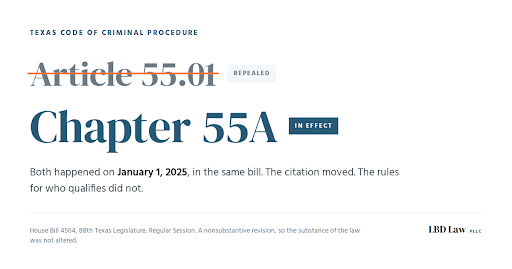
It is Chapter 55A. Texas expunction law is now Code of Criminal Procedure Chapter 55A, added by House Bill 4504 and effective January 1, 2025. The same bill repealed the old Chapter 55, which is where Article 55.01 lived. The citation changed. The rules for who qualifies did not, because House Bill 4504 was a nonsubstantive revision.
You Were Reading The Right Law Under The Wrong Number
If you have spent an evening searching for whether your old arrest can come off your record, you have almost certainly read the words “Article 55.01.” It is on law firm pages. It is on court forms. It is in the article a friend sent you.
And then you found something that said Chapter 55A, and now you are not sure which one is real, or whether the rules changed while you were not looking.
Here is the short version. You were reading the right law. It just does not live at that address anymore.
Nothing you learned about your own eligibility is automatically wrong because the page you read used the old number. That is worth saying out loud, because people in this situation tend to assume the worst about their own case first.
If you are starting from scratch on all of this, the wider picture of how record clearing works in Texas, and how an expunction differs from an order of nondisclosure, is on Clearing Your Record: Expunctions and Orders of Nondisclosure. This page is about one narrower thing, which is the citation that moved.
What Happened To Article 55.01 On January 1, 2025?
Two things happened on the same day, in the same bill.
Texas Code of Criminal Procedure Chapter 55A was added by Acts 2023, 88th Legislature, Regular Session, Chapter 765 (House Bill 4504), Section 1.001, effective January 1, 2025. That is the chapter where Texas expunction law now lives.
The old chapter was repealed by the same act. The note on the old chapter reads:
“this chapter was repealed by Acts 2023, 88th Leg., R.S., Ch. 765 (H.B. 4504), Sec. 3.001(6), eff. January 1, 2025.”
So Article 55.01 is not a competing version of the law, and it is not a stricter or older set of rules someone is trying to hold you to. It is a repealed citation. When a page cites it today, that page has not been updated since before 2025.
Did The Rules For Who Qualifies Change Too?
No, and this is the part that matters most to you.
House Bill 4504 came out of a project the Texas Legislative Council is required to run under Section 323.007 of the Government Code, a complete nonsubstantive revision of the Texas statutes. The Legislature’s own bill analysis says it plainly:
“H.B. 4504 is a nonsubstantive revision of Texas law. The substance of the law has not been altered.”
The same analysis describes what the bill was for: “The sole purpose of these provisions is to compile the relevant law, arrange it in a logical fashion, and rewrite it without altering its meaning or legal effect.”
That is a legislative housekeeping project, not a change in your rights. One long article got broken into a chapter organized by situation. The eligibility conditions came along with it.
We want to be careful here, because “nothing changed” is easy to say and easy to overpromise. What did not change is the substance of the expunction law. What did change is every citation, every article number, and the structure a lawyer or a clerk uses to find your situation. That second part is not nothing. It is why an old form or an old petition template can fail today even when the underlying facts are fine.
Where Did The Old Article 55.01 Rules End up in Chapter 55A?
Chapter 55A is organized by how your case ended, which is a more useful map than one long article was. Here is where the situations people ask about actually sit now.
| What happened in your case | Where it lives |
|---|---|
| You were acquitted at trial | Art. 55A.002 |
| You received a pardon for actual innocence | Art. 55A.003 |
| You received a pardon for another reason | Art. 55A.004 |
| You were arrested by mistaken identity | Art. 55A.006 |
| You were arrested, released, and never finally convicted | Art. 55A.051 |
| You were arrested and no charge was ever filed | Art. 55A.052 |
| Your indictment or information was dismissed or quashed | Art. 55A.053 |
| The limitations period ran out before you could be prosecuted | Art. 55A.054 |
| You were acquitted on appeal, or the prosecutor recommends expunction | Art. 55A.101 |
Article 55A.051 is the gateway for most people. It applies to a person arrested for a felony or misdemeanor if:
“(1) the person has been released; (2) the charge, if any, has not resulted in a final conviction and is no longer pending; and (3) there was no court-ordered community supervision under Chapter 42A for the offense, other than for a Class C misdemeanor.”
Read that third condition twice. It is the one that surprises people, and we come back to it below.
How Long Do You Have To Wait If You Were Arrested And Never Charged?
This is the number people are actually searching for, and Chapter 55A sets it out in Article 55A.052.
Under Texas Code of Criminal Procedure Article 55A.052, the waiting period after an arrest where no charge was ever filed runs from the date of arrest: 180 days for a Class C misdemeanor, one year for a Class A or B misdemeanor, and three years for a felony.
Broken out:
- 180 days from the date of arrest if the arrest was for an offense punishable as a Class C misdemeanor, and there was no felony charge arising out of the same transaction.
- One year from the date of arrest if the arrest was for an offense punishable as a Class B or Class A misdemeanor, and there was no felony charge arising out of the same transaction.
- Three years from the date of arrest if the arrest was for an offense punishable as a felony, or if there was a felony charge arising out of the same transaction.
- No waiting period at all if the attorney representing the state certifies that the arrest records and files are not needed for use in any criminal investigation or prosecution, including one involving another person. That fourth route is in the statute, and it is the one almost nobody knows to ask about.
One more timing rule worth knowing before you plan around a court date. Under Article 55A.254, “The court shall set a hearing on an ex parte petition for expunction not earlier than the 30th day following the date the petition is filed.” Filing does not put you in front of a judge next week.
Why Does An Outdated Citation On A Page Actually Matter?
You might reasonably ask why any of this matters if the substance is the same. Three reasons, and they are practical rather than technical.
A page that still says Article 55.01 has not been reviewed in more than a year and a half. Whatever else is on it is the same age. That includes the waiting periods, the disqualifiers, and the description of what happens after a judge signs.
Forms and petitions carry citations. A petition built on repealed article numbers is a petition a clerk or a court can send back, and that costs you time you already waited for.
And Chapter 55A carries a provision the old chapter’s readers rarely saw. Article 55A.451 says that on release or discharge of an arrested person, “the person responsible for the release or discharge shall give the released or discharged person a written explanation of that person’s rights under this chapter and a copy of the provisions of this chapter.” If you were never handed that, you would have no reason to know any of this existed.
If you are looking at an old arrest and trying to figure out which route in Chapter 55A your case actually falls under, that is a question worth putting in front of someone who reads the current chapter rather than a cached copy of the old one. Lara Bracamonte Davila and LBD Law, PLLC can walk through what your record shows and which article applies, so you are working from the law as it reads today.
CONTACT THE FIRM · www.lbdlawfirm.com/contact · 214-304-6640
What Chapter 55A Still Will Not Do
The recodification did not open any doors that were closed before. A few of those doors matter a great deal to real people.
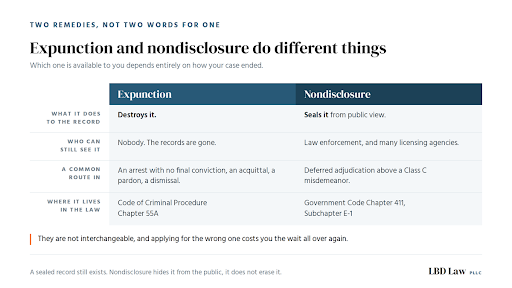
Deferred adjudication above a Class C misdemeanor still blocks expunction. That is the third condition in Article 55A.051, and it catches people who completed everything the court asked of them and reasonably assumed that was the end of it. It is not a punishment for something you did wrong. It is a line in the eligibility rule. The remedy in that situation is an order of nondisclosure under Government Code Chapter 411, Subchapter E-1, which is a different remedy with different rules.
Chapter 55A also has an entire subchapter listing when expunction is prohibited. Article 55A.151 bars expunction where the offense you were acquitted of arose out of a criminal episode and you were convicted of, or remain subject to prosecution for, at least one other offense in that episode. Article 55A.154 bars the Article 55A.052 and 55A.054 routes for a person who intentionally or knowingly absconds from the jurisdiction after being released following an arrest.
And expunction is still not the same thing as sealing. Expunction destroys records. Nondisclosure hides them from the public and leaves them visible to law enforcement and to many licensing agencies. If your goal is a clean background check for a job or a license, which route you need depends entirely on how your case ended. That is worth sorting out before you file anything, because the two are not interchangeable and applying for the wrong one costs you the wait all over again.
Frequently Asked Questions
Is Article 55.01 of the Texas Code of Criminal Procedure still good law?
No. Article 55.01 was part of Code of Criminal Procedure Chapter 55, which was repealed by House Bill 4504, 88th Texas Legislature, Regular Session, effective January 1, 2025. Texas expunction law is now in Code of Criminal Procedure Chapter 55A. A page or form citing Article 55.01 today is citing a repealed statute.
Did the move to Chapter 55A make it harder to get an expunction in Texas?
No. House Bill 4504 was a nonsubstantive revision carried out under Section 323.007 of the Texas Government Code. The Legislature’s bill analysis states that the substance of the law was not altered and that the purpose was to compile and rearrange the law without changing its meaning or legal effect. The eligibility conditions moved to new article numbers rather than changing.
How long after a Texas arrest with no charges filed can I ask for an expunction?
Under Texas Code of Criminal Procedure Article 55A.052, the waiting period runs from the date of arrest: 180 days for a Class C misdemeanor, one year for a Class A or B misdemeanor, and three years for a felony. Those periods apply where no indictment or information was ever presented. There is also a separate route with no waiting period if the attorney representing the state certifies the records are not needed for any criminal investigation or prosecution.
I completed deferred adjudication. Can I get an expunction under Chapter 55A?
Generally no, if the deferred adjudication was for anything above a Class C misdemeanor. Article 55A.051 applies only where there was no court-ordered community supervision under Chapter 42A other than for a Class C misdemeanor. In that situation the remedy people are usually looking for is an order of nondisclosure under Texas Government Code Chapter 411, Subchapter E-1, which seals a record from public view rather than destroying it.
What does an expunction cost to file in Texas?
There is no single statewide figure. Filing costs are set county by county and by court, so the amount in Rockwall County is not necessarily the amount in Collin, Hunt, Kaufman or Dallas County. Confirm the current fee with the district clerk in the county where the petition will be filed rather than relying on a number published on any website.
Key Takeaways
- Texas expunction moved from Code of Criminal Procedure Chapter 55 to Chapter 55A on January 1, 2025, under House Bill 4504. Article 55.01 is a repealed citation.
- The substance of the law did not change. House Bill 4504 was a nonsubstantive revision, and the Legislature’s own bill analysis says the substance of the law has not been altered.
- Where no charge was ever filed, Article 55A.052 sets the wait from the date of arrest at 180 days for a Class C misdemeanor, one year for a Class A or B misdemeanor, and three years for a felony.
- Deferred adjudication above a Class C misdemeanor still keeps a case outside expunction under Article 55A.051. Nondisclosure under Government Code Chapter 411, Subchapter E-1 is the separate remedy.
Your Next Step
An old arrest sitting on your record has a way of feeling permanent, especially when everything you read about it seems to disagree with itself. Most of that confusion is not about your case at all. It is about a citation that moved and a lot of pages that never got updated. The law that decides whether your record can be cleared is the same law it was two years ago, and it is written down, and it can be read.
What it cannot do is sort itself. Which article in Chapter 55A fits your situation depends on how your case actually ended, and that is a detail your paperwork knows better than your memory does.
If you want to know which route in Chapter 55A applies to your record, and whether expunction or nondisclosure is the remedy that fits, LBD Law, PLLC can look at what your case file and your record actually show and tell you plainly what is available. Knowing which of the two you are dealing with is what lets you plan instead of guess.
You can read how the two remedies fit together on Clearing Your Record: Expunctions and Orders of Nondisclosure.